

Description
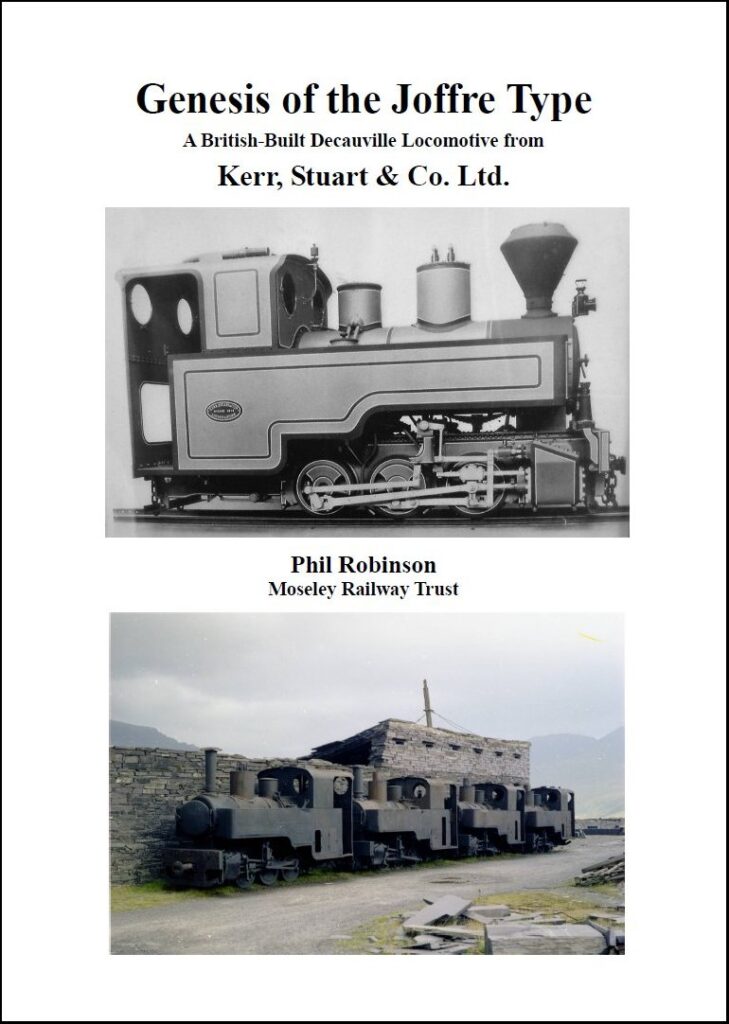
Published in 2026, this book examines the reasons leading up to production of the Kerr Stuart Joffre type 0-6-0T locomotive prior to the Great War of 1914-1918. The design owes its development, in part, to the political will which shaped the main French Railway System prior to the Franco Prussian War of 1870-1871, and how that war influenced Captain Prosper Péchot to evolve the artillery railway equipment which then served the line of great French fortresses along the German Border between around 1890 to the Great War. In the period immediately prior to 1914, the 60cm artillery railways reached the peak of their development, seeing usage in military manoeuvres demonstrating the might of the French Army and how their light railway system could support an attacking force – something which was shown vividly in the Langres military exercises of 1906. In the same period, 60cm gauge railways played a pivotal role in Morocco during the two political crises of 1905-6 and 1911, with the French building a 60cm gauge military railway system which ultimately extended for over 1200km (750 miles). At the outbreak of WW1, the need for vast supplies of war material saw the French Government seeking railway equipment from the USA, and when even the USA’s prodigious output could not fulfil all of the French Army needs, turning to British locomotive builders, notably the North British Locomotive Company in Glasgow, and Kerr Stuart in Stoke on Trent. Orders followed for 70 of the Joffre type in three batches between 1915 and 1916, and fortunately much of the internal Kerr Stuart correspondence has survived to give us a snapshot of how that company operated, and some of the pressures exerted on them by their eager French customer.
The end of WW1 was not the end of the Joffre Story. Former artillery railway locomotives were used in the rebuilding of France in the devastated regions, and many locomotives from the various builders subsequently passed into industry. This story then follows five of the Joffre locomotives to a quarry in the Calais region of France and its vast limestone operation. We follow the acquisition of these five derelict 60cm gauge locomotives by two well-known British enthusiasts, and the display of four of them at Pen-Yr-Orsedd and later Gloddfa Ganol in North Wales. Finally, a look at their final dispersal around the UK and adaptation to new roles on several preserved lines.
This A4 sized book is printed in hardback, with 192 pages containing over 200 photographs, and over 40 images of various documents and drawings, including two locomotive general arrangement drawings and a number of Péchot wagon drawings.
ISBN 978-0-95-767899-6